Understanding Neural Networks for AI Beginners
An accessible introduction to neural networks the foundational technology behind many AI advancements.
An accessible introduction to neural networks, the foundational technology behind many AI advancements.
Understanding Neural Networks for AI Beginners
Hey there, aspiring AI enthusiast! Ever wondered how those super-smart AI systems like ChatGPT or the image generators you see online actually work? Well, a huge part of their magic comes from something called Neural Networks. Don't let the fancy name scare you off; they're actually pretty intuitive once you break them down. Think of them as digital brains, inspired by how our own brains process information. Ready to dive in?
What Exactly Are Neural Networks AI Fundamentals Explained
At its core, a neural network is a series of algorithms that endeavors to recognize underlying relationships in a set of data through a process that mimics the way the human brain operates. Neural networks can adapt to changing input, so the network generates the best possible result without needing to redesign the output criteria. They are particularly good at finding patterns that are too complex for a human to extract and teach a machine to recognize. Imagine you're trying to teach a computer to tell the difference between a cat and a dog. You could write a bunch of rules, like 'if it has pointy ears and whiskers, it's a cat.' But what about a dog with pointy ears? Or a cat without whiskers? It gets complicated fast. Neural networks learn these distinctions by looking at thousands, even millions, of examples, figuring out the subtle patterns on their own.
The Building Blocks Neurons Layers and Connections
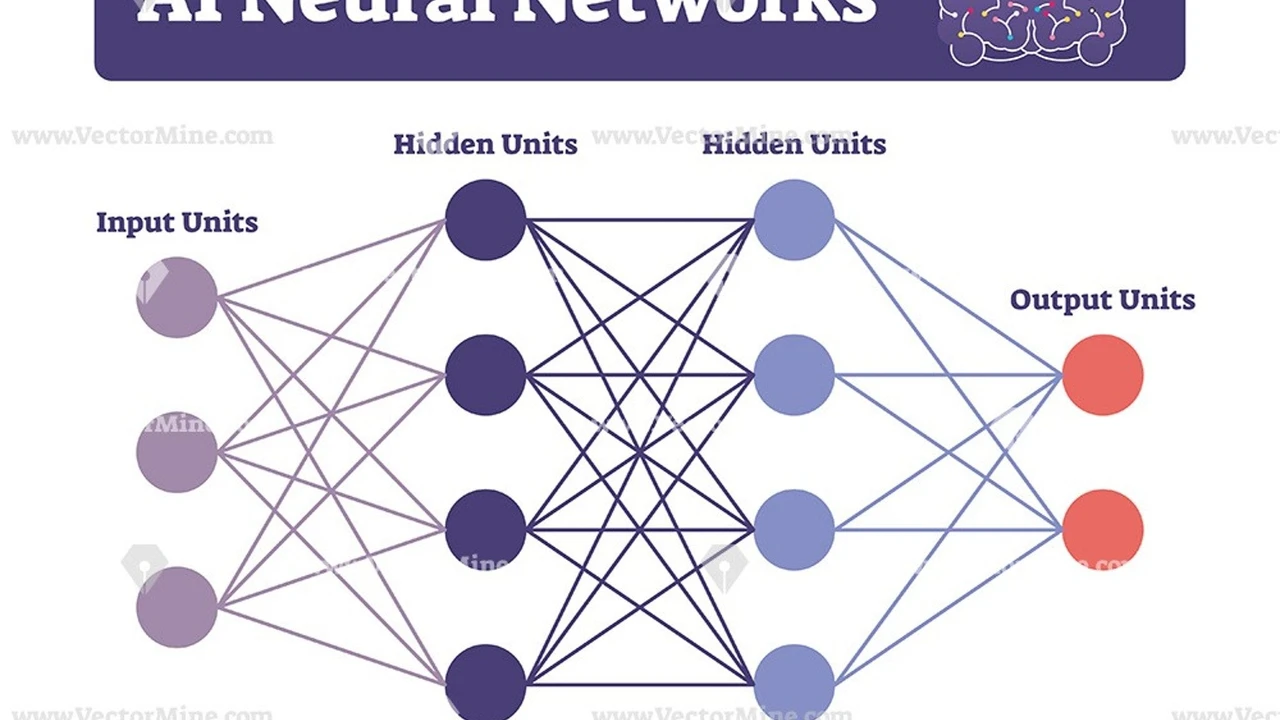
Just like our brains have neurons, neural networks have artificial neurons, often called 'nodes.' These nodes are organized into layers:
- Input Layer: This is where your data enters the network. If you're showing it a picture, each pixel might be an input node.
- Hidden Layers: These are the 'thinking' layers. There can be one or many hidden layers, and this is where the magic of pattern recognition happens. Each node in a hidden layer takes inputs from the previous layer, performs some calculations, and then passes its output to the next layer.
- Output Layer: This is where the network gives you its answer. For our cat vs. dog example, it might have two output nodes: one for 'cat' and one for 'dog,' with the higher value indicating its prediction.
Each connection between nodes has a 'weight' associated with it. Think of weights as the strength or importance of that connection. When the network is learning, it adjusts these weights to improve its predictions. There's also a 'bias' for each neuron, which helps the neuron activate even if all its inputs are zero. It's like a small nudge to get things going.
How Neural Networks Learn Training and Backpropagation
This is where it gets really interesting! Neural networks learn through a process called 'training.' You feed them a massive amount of data (like thousands of cat and dog pictures, each labeled correctly). Here's the simplified breakdown:
- Forward Pass: The input data goes through the network, layer by layer, until it reaches the output layer and makes a prediction.
- Error Calculation: The network's prediction is compared to the actual correct answer. The difference between the two is the 'error.'
- Backpropagation: This is the crucial step. The error is then sent backward through the network, from the output layer to the input layer. As the error propagates backward, the network adjusts the weights and biases of each connection and node in a way that reduces the error for future predictions. It's like telling the network, 'Hey, you were a bit off here, adjust this connection a little bit to get closer next time!'
This process of forward pass, error calculation, and backpropagation is repeated thousands, millions, or even billions of times with different data samples until the network's predictions are consistently accurate. It's an iterative process of trial and error, constantly refining its internal parameters.
Types of Neural Networks Beyond the Basics
While the basic structure is similar, there are many specialized types of neural networks, each designed for different tasks. Here are a few common ones you'll encounter:
Convolutional Neural Networks CNNs for Image Recognition
Keywords: Image Processing, Computer Vision, Feature Extraction, Object Detection
CNNs are the rockstars of image and video processing. They're designed to automatically and adaptively learn spatial hierarchies of features from input images. Think of them as having special 'filters' that scan across an image, picking up on edges, textures, and shapes. This makes them incredibly effective for tasks like:
- Image Classification: Identifying what's in a picture (e.g., cat, dog, car).
- Object Detection: Locating and identifying multiple objects within an image (e.g., finding all the cars in a street scene).
- Facial Recognition: Identifying individuals from images or videos.
Popular Frameworks/Libraries:
- TensorFlow: Developed by Google, it's an open-source machine learning framework. It's incredibly flexible and powerful, used for everything from research to production. It has a steep learning curve for beginners but offers immense control.
- PyTorch: Developed by Facebook's AI Research lab, PyTorch is known for its ease of use and dynamic computational graph, making it popular for research and rapid prototyping. Many cutting-edge AI models are first implemented in PyTorch.
- Keras: A high-level API that runs on top of TensorFlow (and other backends). Keras is designed for fast experimentation with deep neural networks. It's very user-friendly and often recommended for beginners due to its simpler syntax.
Use Cases and Products:
- Google Photos: Uses CNNs to automatically tag and organize your photos by people, places, and objects.
- Self-driving Cars: CNNs process camera feeds to identify pedestrians, other vehicles, traffic signs, and lane markings.
- Medical Imaging: Assisting doctors in detecting diseases like cancer from X-rays or MRIs.
Recurrent Neural Networks RNNs for Sequential Data
Keywords: Natural Language Processing, Time Series, Sequence Prediction, Memory
RNNs are built for handling sequential data, where the order of information matters. Unlike traditional neural networks, RNNs have 'memory,' meaning they can use information from previous steps in a sequence to influence the current output. This makes them perfect for:
- Natural Language Processing (NLP): Understanding and generating human language (e.g., machine translation, text summarization).
- Speech Recognition: Converting spoken words into text.
- Time Series Prediction: Forecasting stock prices, weather patterns, etc.
Popular Frameworks/Libraries:
- TensorFlow and PyTorch: Both frameworks offer robust support for building and training RNNs, including more advanced variants like LSTMs (Long Short-Term Memory) and GRUs (Gated Recurrent Units), which are designed to overcome the 'vanishing gradient' problem in basic RNNs.
Use Cases and Products:
- Google Translate: Uses RNNs (and more advanced Transformer models) to translate text between languages.
- Voice Assistants (Siri, Alexa): Process your spoken commands using RNNs to understand your intent.
- Predictive Text: The suggestions you get while typing on your phone often come from RNNs.
Generative Adversarial Networks GANs for Content Creation
Keywords: Image Generation, Data Synthesis, Deepfakes, Creative AI
GANs are a fascinating type of neural network architecture consisting of two competing networks: a 'generator' and a 'discriminator.' The generator tries to create realistic data (e.g., images), while the discriminator tries to tell the difference between real data and the generator's fakes. They train each other in a continuous game of cat and mouse, leading to incredibly realistic outputs.
- Image Generation: Creating entirely new, realistic images of faces, landscapes, or objects that don't exist.
- Data Augmentation: Generating synthetic data to expand training datasets for other AI models.
- Style Transfer: Applying the artistic style of one image to another.
Popular Frameworks/Libraries:
- PyTorch and TensorFlow: Again, these are the go-to frameworks for implementing GANs due to their flexibility and extensive community support.
Use Cases and Products:
- Art Generation: AI artists use GANs to create unique digital artworks.
- Deepfakes: While controversial, GANs are the underlying technology for generating highly realistic fake videos or audio.
- NVIDIA StyleGAN: A prominent example of a GAN architecture capable of generating incredibly realistic human faces.
Practical Tools and Platforms for AI Development Getting Started
So, you're excited to try building your own neural networks? Awesome! You don't need to be a coding wizard to start. Here are some tools and platforms that can help:
Google Colaboratory Colab Free Cloud GPU Access
Keywords: Free GPU, Python Notebooks, Cloud Computing, Machine Learning Environment
What it is: Colab is a free cloud-based Jupyter notebook environment provided by Google. It allows you to write and execute Python code in your browser, and best of all, it provides free access to powerful GPUs (Graphics Processing Units) and TPUs (Tensor Processing Units) – essential for training large neural networks quickly. You don't need to set up anything on your local machine.
Use Cases: Perfect for learning, experimenting with small to medium-sized datasets, running tutorials, and sharing your code. It integrates seamlessly with Google Drive.
Pricing: Free for basic usage. Colab Pro and Pro+ offer more powerful GPUs, longer runtimes, and more memory for a monthly subscription (e.g., Colab Pro starts around $9.99/month).
Why it's great for beginners: No setup required, free access to powerful hardware, easy to share notebooks.
Jupyter Notebooks Local Development Environment
Keywords: Interactive Computing, Data Science, Python IDE, Local Setup
What it is: Jupyter Notebook is an open-source web application that allows you to create and share documents that contain live code, equations, visualizations, and narrative text. You run it on your own computer.
Use Cases: Ideal for local development, data exploration, prototyping, and creating interactive reports. You have full control over your environment and data.
Pricing: Free and open-source.
Why it's great for beginners: Highly interactive, excellent for step-by-step learning, widely used in data science and machine learning communities.
Kaggle Datasets and Competitions for Learning
Keywords: Data Science Community, Machine Learning Competitions, Public Datasets, Learning Resources
What it is: Kaggle is a subsidiary of Google and is the world's largest community of data scientists and machine learning engineers. It hosts machine learning competitions, provides a vast repository of public datasets, and offers a free cloud-based notebook environment (similar to Colab, often with GPU access).
Use Cases: Finding datasets for your projects, participating in competitions to test your skills, learning from other people's code (kernels), and engaging with a vibrant community.
Pricing: Free.
Why it's great for beginners: Access to real-world data, opportunities to apply what you learn, and a supportive community.
Hugging Face Transformers Library for NLP
Keywords: Natural Language Processing, Pre-trained Models, Large Language Models, Transfer Learning
What it is: Hugging Face is a company that has become central to the open-source NLP community. Their 'Transformers' library provides thousands of pre-trained models (like BERT, GPT-2, T5) that you can use for various NLP tasks with just a few lines of code. This is a game-changer because training these models from scratch requires immense computational power and data.
Use Cases: Text classification, sentiment analysis, question answering, text generation, summarization, and more. It's perfect for building NLP applications without needing to be an expert in deep learning architectures.
Pricing: The library is open-source and free. Hugging Face also offers paid services for enterprise users and hosted solutions.
Why it's great for beginners: Allows you to leverage state-of-the-art NLP models easily, focusing on application rather than complex model building.
The Future of Neural Networks Continuous Evolution
Neural networks are constantly evolving. Researchers are developing new architectures, more efficient training methods, and ways to make them more interpretable and less 'black box.' We're seeing advancements in areas like:
- Explainable AI (XAI): Making AI models more transparent so we can understand why they make certain decisions.
- Federated Learning: Training AI models on decentralized datasets without moving the data, enhancing privacy.
- Neuromorphic Computing: Building hardware specifically designed to mimic the brain's structure, potentially leading to more energy-efficient AI.
The field is moving at an incredible pace, and understanding the fundamentals of neural networks is your key to unlocking this exciting world. So, keep learning, keep experimenting, and who knows what amazing things you'll build!
:max_bytes(150000):strip_icc()/277019-baked-pork-chops-with-cream-of-mushroom-soup-DDMFS-beauty-4x3-BG-7505-5762b731cf30447d9cbbbbbf387beafa.jpg)