Best AI Tools for SEO Keyword Research
Optimize your website with AI-powered tools for in-depth keyword research and content strategy.
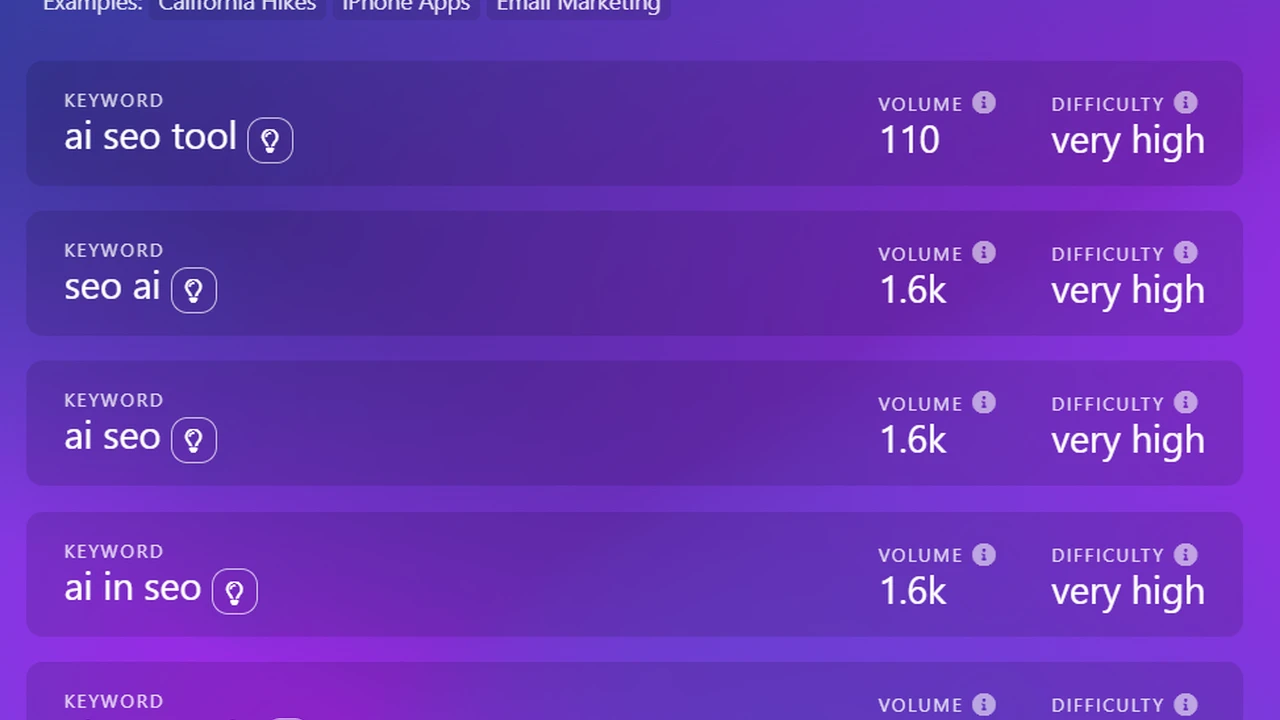
Optimize your website with AI-powered tools for in-depth keyword research and content strategy.
Best AI Tools for SEO Keyword Research
Hey there, fellow digital marketers and content creators! Ever feel like you're playing a never-ending game of hide-and-seek with keywords? You know, those magical words and phrases that connect your amazing content with the people actively searching for it online? Well, you're not alone. Keyword research has always been the bedrock of any successful SEO strategy. But let's be real, it can be a tedious, time-consuming, and sometimes downright frustrating process. That's where AI comes in, swooping in like a superhero to revolutionize how we find, analyze, and leverage keywords.
Gone are the days of manually sifting through endless spreadsheets or relying solely on your gut feeling. AI-powered keyword research tools are changing the game, offering unparalleled insights, efficiency, and accuracy. They can process vast amounts of data in seconds, identify hidden opportunities, predict trends, and even help you understand user intent better than ever before. If you're serious about ranking higher, driving more organic traffic, and ultimately growing your online presence, then embracing these AI tools isn't just an option; it's a necessity.
In this comprehensive guide, we're going to dive deep into the world of AI-driven keyword research. We'll explore why these tools are so powerful, what features to look for, and most importantly, we'll compare some of the best options available on the market today. We'll talk about their unique selling points, ideal use cases, pricing, and even some practical tips on how to integrate them into your existing workflow. So, buckle up, because by the end of this, you'll be armed with the knowledge to supercharge your SEO efforts and dominate the search rankings!
Why AI is a Game Changer for Keyword Research and SEO Strategy
So, what makes AI such a big deal for keyword research? It's more than just automation; it's about intelligence at scale. Traditional keyword research often involves a lot of manual effort, educated guesses, and limited data sets. AI, on the other hand, can analyze billions of data points, understand complex relationships, and even predict future trends with remarkable accuracy. Let's break down some of the key advantages:
Uncovering Hidden Keyword Opportunities and Long Tail Keywords
One of the biggest headaches in keyword research is finding those elusive long-tail keywords – specific, often longer phrases that users type into search engines. While they might have lower search volume individually, they often have higher conversion rates because they indicate a more specific user intent. AI tools excel at identifying these. They can analyze natural language patterns, forum discussions, question-and-answer sites, and even voice search queries to unearth long-tail gems that traditional tools might miss. Imagine finding a niche keyword with low competition but high commercial intent – that's an AI superpower right there.
Understanding User Intent and Semantic SEO
Google and other search engines are getting smarter. They're moving beyond just matching keywords to understanding the underlying intent behind a user's query. This is where semantic SEO comes into play. AI tools can analyze the context of keywords, related topics, and user behavior to help you understand not just what people are searching for, but why they're searching for it. Are they looking for information (informational intent), trying to buy something (transactional intent), or looking for a specific website (navigational intent)? Knowing this allows you to create content that truly resonates with your audience and satisfies their needs, leading to higher engagement and better rankings.
Predicting Keyword Trends and Market Shifts
The digital landscape is constantly evolving. New trends emerge, search volumes fluctuate, and competitor strategies shift. AI tools can analyze historical data, current search patterns, and even social media trends to predict which keywords are gaining traction and which are losing steam. This foresight allows you to be proactive, creating content around emerging topics before your competitors even realize they exist. Imagine being able to jump on a trending keyword before it becomes saturated – that's a massive competitive advantage.
Competitive Keyword Analysis and Gap Analysis
Knowing what your competitors are doing is crucial. AI tools can perform deep dives into your competitors' keyword strategies, identifying the keywords they rank for, their top-performing content, and even their backlink profiles. More importantly, they can perform gap analysis, showing you keywords that your competitors are ranking for, but you're not. This reveals untapped opportunities and helps you refine your own content strategy to steal some of their organic traffic.
Content Ideation and Topic Clustering
Beyond just finding keywords, AI can help you brainstorm entire content ideas and organize them into logical topic clusters. Instead of creating isolated pieces of content, AI can suggest related keywords and topics that allow you to build comprehensive content hubs. This not only improves your site's authority on a given subject but also helps search engines understand the breadth and depth of your expertise, leading to better overall rankings.
Key Features to Look for in AI Keyword Research Tools and SEO Platforms
When you're evaluating AI keyword research tools, it's easy to get overwhelmed by the sheer number of features. To help you cut through the noise, here are some essential capabilities to prioritize:
Comprehensive Keyword Databases and Data Sources
The more data a tool has access to, the better its insights will be. Look for tools that pull data from various sources, including Google Keyword Planner, Google Search Console, Bing, YouTube, Amazon, and even social media platforms. A vast and regularly updated database ensures you're getting the most accurate and current keyword information.
Advanced Filtering and Segmentation Options
Raw keyword lists can be massive. Effective AI tools will offer robust filtering options, allowing you to narrow down results by search volume, competition level, cost-per-click (CPC), number of words, intent, and more. The ability to segment keywords by topic, intent, or even geographic location is also incredibly valuable.
Competitor Analysis and SERP Features Tracking
A good tool won't just show you keywords; it will show you who's ranking for them. Look for features that allow you to analyze competitor domains, see their top keywords, and identify their content strategies. Tracking SERP (Search Engine Results Page) features like featured snippets, local packs, image carousels, and video results is also crucial, as these can significantly impact click-through rates.
Content Gap Analysis and Opportunity Identification
As mentioned earlier, the ability to identify keywords that your competitors rank for but you don't is a goldmine. This feature helps you pinpoint immediate content opportunities and prioritize your efforts.
Keyword Difficulty and Competition Metrics
Understanding how hard it will be to rank for a particular keyword is vital. AI tools provide various metrics for keyword difficulty, often factoring in domain authority, backlink profiles, and content quality of ranking pages. While these are estimates, they provide a valuable guide for prioritizing your keyword targets.
Integration with Other SEO Tools and Platforms
Seamless integration with other tools in your SEO stack (like content optimization tools, rank trackers, or analytics platforms) can significantly streamline your workflow. Look for APIs or direct integrations that make data transfer easy.
User-Friendly Interface and Reporting
Even the most powerful AI tool is useless if you can't understand its output. A clean, intuitive interface with clear visualizations and customizable reporting options is essential for efficient analysis and presenting your findings to clients or team members.
Top AI Powered Keyword Research Tools and Platforms Compared
Alright, let's get to the good stuff! Here's a breakdown of some of the leading AI-powered keyword research tools on the market, complete with their unique strengths, ideal use cases, and pricing structures.
1. Semrush Keyword Magic Tool
Overview: Semrush is an all-in-one SEO powerhouse, and its Keyword Magic Tool is a standout feature, heavily leveraging AI to provide comprehensive keyword insights. It boasts one of the largest keyword databases globally and offers an incredible array of filtering and analysis options.
Key AI-Powered Features:
- Keyword Magic Tool: Generates millions of keyword ideas from a single seed keyword, categorized by topic and intent.
- Keyword Gap Analysis: Compares your keyword profile against competitors to find missed opportunities.
- Topic Research Tool: Helps you discover trending topics and content ideas based on keywords, providing questions people ask and related searches.
- Keyword Difficulty Score: Provides a highly accurate difficulty score based on various factors, including SERP analysis.
- Intent Filters: Allows you to filter keywords by commercial, informational, navigational, or transactional intent.
Ideal Use Case: Best for agencies, large businesses, and experienced SEO professionals who need a comprehensive suite of tools beyond just keyword research. It's excellent for deep competitive analysis and content strategy development.
Pricing: Semrush offers several plans. The Pro plan starts at around $129.95/month (billed annually), Guru at $249.95/month, and Business at $499.95/month. They often have free trials available.
Pros: Extremely comprehensive, vast keyword database, excellent competitive analysis, robust reporting, integrates well with other Semrush tools.
Cons: Can be overwhelming for beginners due to the sheer number of features, higher price point.
2. Ahrefs Keywords Explorer
Overview: Ahrefs is another industry giant, renowned for its backlink analysis but equally powerful in keyword research. Its Keywords Explorer is intuitive and provides deep insights into search volume, keyword difficulty, and SERP overview.
Key AI-Powered Features:
- Keywords Explorer: Generates thousands of keyword ideas from a seed keyword, showing search volume, keyword difficulty, and traffic potential.
- Parent Topic: Identifies the broader topic a keyword belongs to, helping with content clustering.
- SERP Overview: Provides detailed analysis of the top 10 ranking pages for any keyword, including their domain rating, backlinks, and estimated traffic.
- Questions Report: Automatically pulls questions related to your seed keyword, perfect for 'People Also Ask' sections and informational content.
- Keyword Difficulty Score: Ahrefs' KD score is highly respected and considers the number of referring domains needed to rank.
Ideal Use Case: Great for content marketers, SEO specialists, and small to medium-sized businesses who prioritize strong keyword data and competitive analysis, especially backlink-driven insights.
Pricing: Lite plan starts at $99/month (billed annually), Standard at $199/month, Advanced at $399/month, and Enterprise at $999/month.
Pros: Excellent keyword difficulty metric, strong SERP analysis, intuitive interface, powerful backlink data integration, great for content ideation.
Cons: Can be pricey for very small businesses, some features might require a learning curve.
3. Surfer SEO
Overview: While primarily known as a content optimization tool, Surfer SEO has integrated powerful AI-driven keyword research capabilities, focusing on helping you create content that ranks by understanding what Google truly wants.
Key AI-Powered Features:
- Keyword Research Tool: Generates keyword ideas and clusters them into topics based on semantic relevance.
- Content Planner: Helps you build comprehensive content strategies by suggesting related topics and keywords to cover.
- SERP Analyzer: Analyzes the top-ranking pages for a keyword, providing data on word count, headings, images, and keyword usage.
- NLP (Natural Language Processing) Integration: Uses NLP to identify important terms and phrases that Google expects to see in content for a given keyword.
Ideal Use Case: Perfect for content writers, SEO content strategists, and anyone focused on creating highly optimized, semantically rich content that ranks. It's less about finding raw keywords and more about optimizing for them.
Pricing: Basic plan starts at $69/month (billed annually), Pro at $119/month, and Business at $239/month.
Pros: Excellent for content optimization, strong NLP capabilities, helps with topic clustering, user-friendly for content creators.
Cons: Not a standalone keyword research tool; best used in conjunction with other platforms, limited raw keyword data compared to Semrush/Ahrefs.
4. GrowthBar
Overview: GrowthBar is an AI-powered SEO tool designed for speed and simplicity, making it ideal for bloggers, small businesses, and marketers who need quick keyword insights without the complexity of larger suites.
Key AI-Powered Features:
- Keyword Research: Provides keyword suggestions, search volume, and competition scores directly within your browser (via a Chrome extension).
- Content Outline Generator: Uses AI to generate content outlines, including headings, questions, and related keywords, based on a target keyword.
- Competitor Analysis: Offers quick insights into competitor keywords, backlinks, and organic traffic.
- AI Content Creation: Includes features for generating blog post ideas and even full paragraphs using AI.
Ideal Use Case: Best for bloggers, small business owners, and content creators who need a fast, easy-to-use tool for keyword research and content ideation without a steep learning curve.
Pricing: Standard plan starts at $48/month (billed annually), Pro at $99/month, and Agency at $199/month. They offer a 7-day free trial.
Pros: Very user-friendly, excellent Chrome extension, quick content outline generation, affordable for small teams.
Cons: Less comprehensive data than enterprise-level tools, primarily focused on content creation rather than deep SEO audits.
5. AnswerThePublic (now part of Neil Patel's Ubersuggest)
Overview: AnswerThePublic is famous for its unique visualization of keyword data, specifically focusing on questions, prepositions, comparisons, and alphabetical searches related to a seed keyword. It's fantastic for understanding user intent and generating content ideas around common queries.
Key AI-Powered Features:
- Question-Based Keyword Generation: Automatically pulls questions people ask around a topic, categorized by 'who,' 'what,' 'where,' 'when,' 'why,' 'how,' 'are,' 'which,' 'will,' etc.
- Preposition and Comparison Keywords: Identifies keywords using prepositions (e.g., 'for,' 'with,' 'to') and comparisons (e.g., 'vs,' 'like').
- Alphabetical and Related Searches: Provides a comprehensive list of keywords organized alphabetically and by related terms.
- Visualizations: Presents data in intuitive, shareable visual maps.
Ideal Use Case: Excellent for content marketers, bloggers, and anyone looking to create highly targeted, question-and-answer style content, FAQs, or content that directly addresses user pain points. Great for understanding the 'voice of the customer.'
Pricing: While it used to have a free tier with limited searches, it's now integrated into Ubersuggest's paid plans. Ubersuggest's Individual plan starts at $29/month (billed annually), Business at $49/month, and Enterprise/Agency at $99/month.
Pros: Unparalleled for question-based keyword research, great for understanding user intent, visually appealing data, excellent for content ideation.
Cons: Not a comprehensive SEO suite, limited in terms of competitive analysis or technical SEO features, now requires a paid Ubersuggest subscription for full functionality.
6. Clearscope
Overview: Clearscope is a content optimization platform that uses AI and natural language processing (NLP) to help you create highly relevant and authoritative content. While not a traditional keyword research tool in the sense of generating massive lists, it excels at helping you use keywords effectively within your content.
Key AI-Powered Features:
- Content Optimization Score: Provides a real-time grade for your content based on its relevance to a target keyword and related terms.
- Term Recommendations: Suggests important keywords and phrases (entities) that Google expects to see in content for a given topic.
- Competitor Content Analysis: Analyzes top-ranking content to identify common themes, headings, and keyword usage patterns.
- Readability and Grade Level Analysis: Helps ensure your content is accessible to your target audience.
Ideal Use Case: Best for enterprise-level content teams, agencies, and serious content marketers who want to ensure their content is perfectly optimized for semantic SEO and user intent. It's about quality over quantity in keyword usage.
Pricing: Clearscope is known for its enterprise-level pricing, which is not publicly listed and typically requires a custom quote. Expect it to be significantly higher than the other tools mentioned, likely starting in the hundreds or thousands per month.
Pros: Extremely accurate NLP, excellent for semantic SEO, helps create truly authoritative content, great for large content teams.
Cons: Very expensive, not a standalone keyword research tool, steep learning curve for some features.
Practical Tips for Leveraging AI Keyword Tools in Your Workflow
Having these powerful AI tools is one thing; knowing how to use them effectively is another. Here are some practical tips to integrate them into your SEO and content strategy:
Start with Broad Seed Keywords and Refine
Don't be afraid to start with a very broad seed keyword (e.g., 'digital marketing'). Let the AI tool generate a massive list of related terms. Then, use the advanced filters to narrow down your results based on search volume, keyword difficulty, and intent. This top-down approach ensures you don't miss any opportunities.
Focus on User Intent, Not Just Volume
High search volume is great, but if the intent doesn't match your content or business goals, it's useless. Use AI tools to identify keywords with clear informational, transactional, or commercial intent. For example, 'best running shoes' indicates transactional intent, while 'how to choose running shoes' is informational. Tailor your content accordingly.
Prioritize Long-Tail Keywords with Low Competition
Especially for newer websites or those in competitive niches, targeting long-tail keywords with lower competition but decent search volume can be a quick win. AI tools are excellent at unearthing these. These keywords often convert better because they address very specific user needs.
Perform Regular Competitor Keyword Analysis
Your competitors aren't static, and neither should your strategy be. Use AI tools to regularly monitor your competitors' keyword rankings, new content, and overall SEO performance. Identify their strengths and weaknesses, and use that information to refine your own strategy.
Use AI for Content Clustering and Topic Authority
Instead of creating isolated blog posts, use AI tools to identify related keywords and topics that can be grouped into content clusters. This helps you build authority on a broader subject, which search engines love. For example, if your main topic is 'content marketing,' you might have sub-topics like 'blog post ideas,' 'SEO writing,' and 'content promotion,' all interlinked.
Integrate Keyword Research with Content Creation
Don't just find keywords and then forget about them. Use tools like Surfer SEO or Clearscope to ensure your content is optimized for those keywords and related terms. This means incorporating them naturally into your headings, body text, and meta descriptions, without keyword stuffing.
Monitor Your Keyword Rankings and Adjust
Keyword research isn't a one-and-done task. Use rank tracking features (often included in these AI suites) to monitor your performance. If a keyword isn't ranking as expected, revisit your content, check competitor strategies, and make adjustments. AI can help you identify why you're not ranking and suggest improvements.
Embrace AI for Content Ideation and Outline Generation
Stuck for content ideas? Use the AI features to brainstorm topics, generate outlines, and even draft initial paragraphs. This can significantly speed up your content creation process, allowing you to focus on refining and adding your unique voice.
The Future of Keyword Research and AI in SEO
The integration of AI into keyword research is just the beginning. As AI models become more sophisticated, we can expect even more advanced capabilities. Imagine AI tools that can:
- Predict hyper-local keyword trends: Identifying micro-trends in specific geographic areas with even greater accuracy.
- Analyze voice search nuances: Understanding the subtle differences in how people speak their queries versus type them.
- Generate entire content briefs: Providing not just keywords, but full content outlines, suggested word counts, and even competitor analysis for every piece of content.
- Automate content updates: Suggesting specific sections of existing content that need updating based on new keyword trends or competitor movements.
- Integrate with user behavior analytics: Connecting keyword performance directly to on-site user engagement metrics to provide a holistic view of content effectiveness.
The goal isn't for AI to replace human SEO specialists or content creators. Instead, it's about empowering us with better data, deeper insights, and more efficient workflows. AI handles the heavy lifting of data analysis, allowing us to focus on strategy, creativity, and building genuine connections with our audience. By embracing these AI-powered tools, you're not just keeping up with the times; you're positioning yourself at the forefront of the digital marketing revolution.
So, go forth, experiment with these incredible tools, and watch your organic traffic soar. The future of SEO is intelligent, and it's here now.
:max_bytes(150000):strip_icc()/277019-baked-pork-chops-with-cream-of-mushroom-soup-DDMFS-beauty-4x3-BG-7505-5762b731cf30447d9cbbbbbf387beafa.jpg)