{ "article": [ { "title": "From Idea to AI Product A Development Roadmap", "meta_description": "A step-by-step guide to taking an AI concept from initial idea to a deployable product.", "content": "A step-by-step guide to taking an AI concept from initial idea to a deployable product.\n\n
\n\n
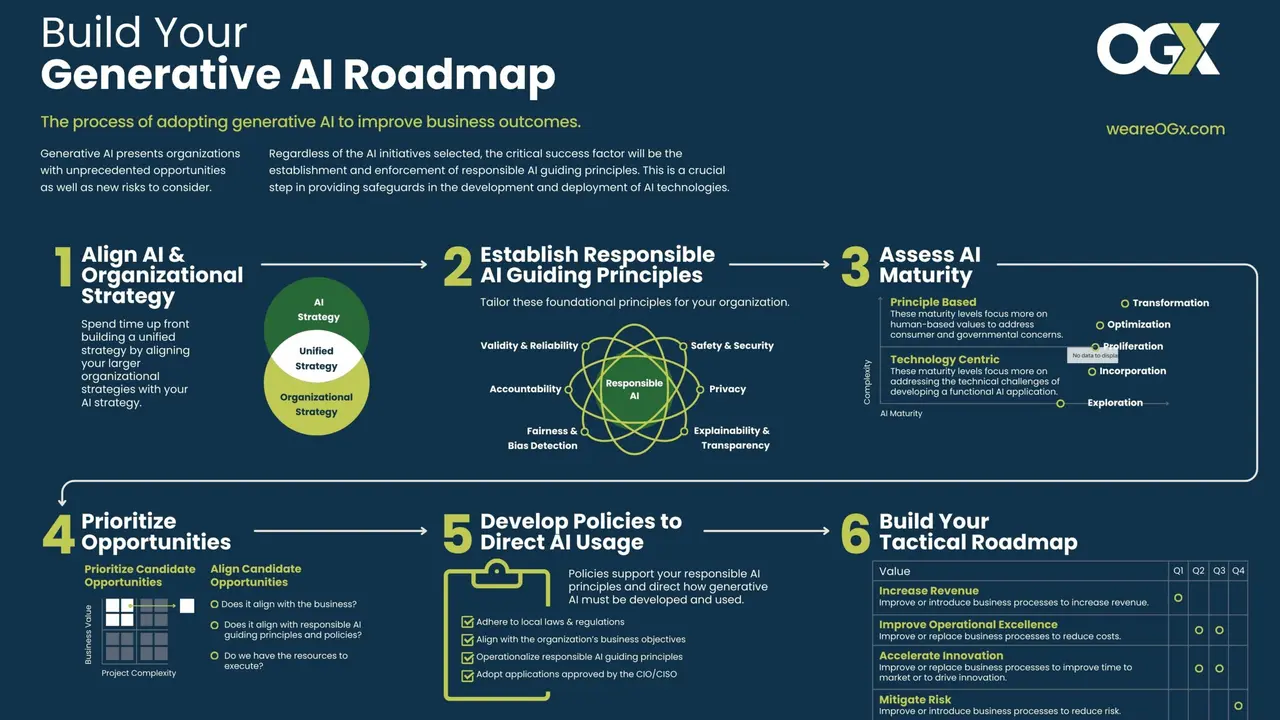
Understanding the AI Product Lifecycle
\n\nSo, you've got this brilliant idea for an AI product, right? That's awesome! But turning that 'aha!' moment into something tangible, something users can actually interact with and benefit from, is a whole different ball game. It's not just about coding; it's about a structured journey, a roadmap if you will, that takes you from a vague concept to a fully deployed, impactful AI solution. Think of it like building a house: you don't just start laying bricks. You need blueprints, materials, a construction crew, and a clear plan. The AI product development lifecycle is pretty similar, just with more data and algorithms.\n\nThis journey typically involves several key phases: ideation and problem definition, data collection and preparation, model selection and training, deployment, and finally, monitoring and iteration. Each phase is crucial, and skipping steps or doing them haphazardly can lead to a product that doesn't quite hit the mark, or worse, fails entirely. We're going to break down each of these stages, giving you practical advice, tool recommendations, and real-world scenarios to help you navigate this exciting but challenging landscape.\n\n
Phase 1 Ideation and Problem Definition for AI Solutions
\n\nThis is where it all begins. Before you even think about algorithms or datasets, you need to clearly define the problem you're trying to solve and how AI can uniquely address it. Don't just build AI for AI's sake. Ask yourself:\n\n* **What specific pain point are you addressing?** Is it a lack of efficiency, a need for better predictions, or a desire to automate a tedious task?\n* **Who is your target user?** Understanding their needs, behaviors, and existing workflows is paramount.\n* **Why is AI the right solution?** Could a traditional software solution work just as well, or does AI offer a significant advantage (e.g., handling complex patterns, learning from data, personalization)?\n* **What does success look like?** Define clear, measurable metrics for your product's performance and impact.\n\nLet's say your idea is to help small e-commerce businesses reduce customer churn. The pain point is lost revenue due to customers leaving. Your target users are small e-commerce store owners. AI is a good fit because it can analyze vast amounts of customer data (purchase history, browsing behavior, support interactions) to predict who is likely to churn and suggest proactive interventions. Success might be measured by a 10% reduction in churn rate within six months.\n\nDuring this phase, it's also vital to conduct thorough market research. Are there existing solutions? What are their strengths and weaknesses? How will your AI product differentiate itself? This isn't just about competition; it's about understanding the landscape and finding your unique value proposition.\n\n
Phase 2 Data Collection and Preparation The Foundation of AI Products
\n\nAI models are only as good as the data they're trained on. This phase is often the most time-consuming and critical. You need to identify, collect, clean, and prepare the data that will feed your AI model.\n\n* **Data Identification:** What data do you need to solve your defined problem? For our e-commerce churn example, this might include customer demographics, purchase history, website activity logs, customer service interactions, email open rates, and more.\n* **Data Collection:** Where will you get this data? It could be internal databases, public datasets, web scraping (be ethical and legal!), or even manual annotation. For e-commerce, you'd likely integrate with their existing CRM, sales platforms (like Shopify or WooCommerce), and analytics tools.\n* **Data Cleaning:** Real-world data is messy. You'll encounter missing values, inconsistencies, outliers, and errors. This step involves handling these issues. For instance, if a customer's age is listed as 'abc', you'd need to decide whether to remove that record, impute a value, or flag it.\n* **Data Transformation/Feature Engineering:** This is where you turn raw data into features that your AI model can understand and learn from. For churn prediction, you might create features like 'days since last purchase', 'average order value', 'number of support tickets in last 30 days', or 'product categories browsed'. This often requires domain expertise.\n* **Data Splitting:** Typically, you'll split your dataset into training, validation, and test sets. The training set is used to teach the model, the validation set to tune its parameters, and the test set to evaluate its final performance on unseen data.\n\n**Tools for Data Collection and Preparation:**\n\n* **Databases:** PostgreSQL, MongoDB, MySQL for storing structured and unstructured data.\n* **ETL Tools:** Apache NiFi, Talend, Fivetran for extracting, transforming, and loading data.\n* **Data Cleaning Libraries (Python):** Pandas, NumPy for data manipulation and cleaning.\n* **Cloud Data Platforms:** Google Cloud BigQuery, AWS S3, Azure Data Lake Storage for scalable data storage and processing.\n* **Annotation Tools:** Labelbox, Scale AI for labeling data (e.g., images, text) if you're working with supervised learning and need human-annotated ground truth.\n\n
Phase 3 Model Selection and Training Building the AI Brain
\n\nWith your data ready, it's time to choose and train your AI model. This is often what people think of when they hear 'AI development'.\n\n* **Model Selection:** Based on your problem type (e.g., classification, regression, clustering, natural language processing, computer vision), you'll select an appropriate AI model architecture. For churn prediction (a classification problem: churn or not churn), you might consider Logistic Regression, Random Forests, Gradient Boosting Machines (like XGBoost or LightGBM), or even simple Neural Networks.\n* **Model Training:** This involves feeding your prepared training data to the chosen model. The model learns patterns and relationships within the data. This is an iterative process where you adjust hyperparameters (settings that control the learning process) to optimize performance.\n* **Model Evaluation:** Using your validation set, you'll evaluate the model's performance based on predefined metrics (e.g., accuracy, precision, recall, F1-score for classification; RMSE for regression). This helps you compare different models and fine-tune the chosen one.\n* **Hyperparameter Tuning:** This is the art and science of finding the best combination of hyperparameters for your model. Techniques include grid search, random search, and more advanced methods like Bayesian optimization.\n\n**Tools for Model Selection and Training:**\n\n* **Machine Learning Frameworks (Python):**\n * **Scikit-learn:** Excellent for traditional machine learning algorithms (classification, regression, clustering) and a great starting point for many problems. It's user-friendly and well-documented.\n * **TensorFlow/Keras:** Powerful for deep learning, especially for complex tasks like image recognition, natural language processing, and large-scale models. Keras provides a high-level API making TensorFlow more accessible.\n * **PyTorch:** Another leading deep learning framework, favored by researchers for its flexibility and Pythonic interface. Often used for cutting-edge research and complex custom models.\n* **Cloud AI Platforms:**\n * **Google Cloud AI Platform:** Offers managed services for training, deploying, and managing ML models. Includes AutoML for automated model building, Vertex AI for MLOps, and pre-trained APIs.\n * **AWS SageMaker:** A comprehensive service for building, training, and deploying machine learning models at scale. Provides notebooks, built-in algorithms, and MLOps capabilities.\n * **Azure Machine Learning:** Microsoft's cloud-based platform for end-to-end machine learning lifecycle management, offering tools for data preparation, model training, deployment, and monitoring.\n* **MLOps Platforms:**\n * **MLflow:** An open-source platform for managing the end-to-end machine learning lifecycle, including experiment tracking, reproducible runs, and model packaging.\n * **Weights & Biases:** A popular platform for experiment tracking, model visualization, and collaboration in deep learning projects.\n\n**Product Comparison Example: Cloud AI Platforms for Model Training**\n\n| Feature/Product | Google Cloud AI Platform (Vertex AI) | AWS SageMaker | Azure Machine Learning |
|---|---|---|---|
| **Ease of Use** | High, especially with AutoML and managed services. Vertex AI unifies many tools. | Moderate to High. Can be complex for beginners but offers many managed options. | Moderate to High. Good integration with Azure ecosystem. |
| **Deep Learning Support** | Excellent, strong integration with TensorFlow/Keras and PyTorch. | Excellent, widely used for deep learning, supports all major frameworks. | Excellent, strong support for PyTorch, TensorFlow, and ONNX. |
| **MLOps Capabilities** | Very strong with Vertex AI, offering robust MLOps features for deployment, monitoring, and governance. | Comprehensive MLOps features including SageMaker Pipelines, Model Monitor, and Feature Store. | Strong MLOps capabilities with Azure ML Pipelines, Model Registry, and Data Drift detection. |
| **Pricing Model** | Pay-as-you-go, based on compute, storage, and API calls. Can be cost-effective for smaller projects, scales well. | Pay-as-you-go, based on instance types, storage, and data transfer. Can get expensive for large-scale, continuous training. | Pay-as-you-go, based on compute, storage, and services used. Offers various tiers and pricing options. |
| **Target Audience** | Developers and data scientists looking for integrated, scalable ML solutions, especially those already in Google Cloud. | Data scientists and engineers needing a highly customizable and scalable platform, often preferred by AWS users. | Enterprises and developers within the Microsoft ecosystem, offering strong integration with other Azure services. |
| **Specific Use Case** | Rapid prototyping with AutoML, complex deep learning projects, MLOps at scale. | End-to-end ML lifecycle management, custom model development, large-scale data processing. | Enterprise-grade ML solutions, strong for MLOps, good for hybrid cloud scenarios. |
| **Approximate Cost (Example)** | Training a medium-sized model for 10 hours on a GPU instance might cost $50-150, depending on GPU type. | Similar range, potentially slightly higher for comparable instances, but varies greatly by region and instance type. | Comparable to AWS, with potential for cost optimization through reserved instances or specific Azure plans. |
*Note: Pricing is highly variable based on region, instance type, duration, and specific services used. Always check the latest pricing on their official websites.*
Phase 4 Deployment Making Your AI Product Accessible
\n\nOnce your model is trained and evaluated, it's time to deploy it so users can actually interact with it. Deployment strategies vary widely depending on your product's nature.\n\n* **API Deployment:** For many AI products, especially those integrated into existing applications, deploying the model as a REST API is common. This allows other services or front-end applications to send data to your model and receive predictions.\n* **Edge Deployment:** For applications requiring real-time inference or operating in environments with limited connectivity (e.g., smart devices, drones), deploying the model directly onto the device (edge computing) is necessary.\n* **Web Application Integration:** If your AI product is a standalone web application, you'll integrate the model into the backend of your web framework (e.g., Flask, Django, Node.js).\n* **Containerization:** Using Docker to containerize your model and its dependencies ensures consistency across different environments (development, testing, production).\n* **Orchestration:** Tools like Kubernetes help manage and scale your containerized applications, ensuring high availability and efficient resource utilization.\n\n**Tools for Deployment:**\n\n* **Web Frameworks:** Flask, Django (Python), Node.js (JavaScript), Ruby on Rails (Ruby) for building the application interface.\n* **Containerization:** Docker for packaging your application and its dependencies.\n* **Orchestration:** Kubernetes for managing containerized applications at scale.\n* **Cloud Deployment Services:**\n * **Google Cloud Run/App Engine/Kubernetes Engine:** For deploying containerized applications and APIs.\n * **AWS Lambda/Elastic Beanstalk/ECS/EKS:** Serverless functions, managed application platforms, and container orchestration.\n * **Azure Functions/App Service/AKS:** Serverless compute, managed web apps, and Kubernetes service.\n* **Model Serving Frameworks:** TensorFlow Serving, TorchServe, ONNX Runtime for optimized model inference.\n\n**Product Comparison Example: Cloud Deployment Services for AI APIs**\n\n| Feature/Product | Google Cloud Run | AWS Lambda | Azure Functions |
|---|---|---|---|
| **Type** | Serverless container platform | Serverless function-as-a-service (FaaS) | Serverless function-as-a-service (FaaS) |
| **Ideal Use Case** | Deploying containerized AI models as APIs, web services, or background jobs. Good for stateless services. | Event-driven AI inference (e.g., image processing on S3 upload, real-time data stream analysis). | Event-driven AI inference, integrating with other Azure services, microservices. |
| **Scalability** | Scales automatically from zero to thousands of instances based on traffic. | Scales automatically based on incoming requests/events. | Scales automatically based on triggers. |
| **Cost Model** | Pay-per-use, billed per CPU, memory, and request. Very cost-effective for sporadic or variable traffic. | Pay-per-invocation and compute duration. Cost-effective for short-lived, event-driven tasks. | Pay-per-execution and resource consumption. Similar to Lambda. |
| **Ease of Use** | Very high. Deploy a Docker image and it just runs. | High. Write a function, configure triggers. | High. Write a function, configure triggers. |
| **Cold Start** | Can have cold starts, but generally faster than FaaS for complex containers. | Can have noticeable cold starts for infrequent invocations. | Can have noticeable cold starts. |
| **Approximate Cost (Example)** | A simple AI API receiving 1 million requests/month might cost $5-20, depending on resource usage. | A function invoked 1 million times with short execution might cost $1-5. | Similar to Lambda, potentially slightly more or less depending on specific plan. |
*Note: These are simplified examples. Actual costs depend heavily on usage patterns, memory, CPU, and region.*
Phase 5 Monitoring and Iteration Continuous Improvement for AI Products
\n\nDeployment isn't the end; it's just the beginning. AI models degrade over time due to concept drift (the relationship between input and output changes) or data drift (the characteristics of the input data change). Continuous monitoring and iteration are essential.\n\n* **Performance Monitoring:** Track key metrics (e.g., model accuracy, latency, throughput, error rates) in real-time. Set up alerts for significant drops in performance.\n* **Data Drift Detection:** Monitor the distribution of your input data to detect changes that might impact model performance. For our churn example, if customer demographics or purchasing habits suddenly shift, the model might become less accurate.\n* **Concept Drift Detection:** Monitor the relationship between your model's predictions and the actual outcomes. If the factors leading to churn change over time, your model needs to learn the new patterns.\n* **Feedback Loops:** Establish mechanisms for collecting user feedback and incorporating it into future model improvements. This could be explicit (e.g., 'Was this prediction helpful?') or implicit (e.g., user behavior after a recommendation).\n* **Retraining and Redeployment:** Based on monitoring insights, you'll periodically retrain your model with new data, fine-tune it, and redeploy the updated version. This is a continuous cycle.\n* **A/B Testing:** For new model versions or features, conduct A/B tests to compare their performance against the existing version in a live environment before full rollout.\n\n**Tools for Monitoring and MLOps:**\n\n* **MLOps Platforms:**\n * **MLflow:** As mentioned, it's great for experiment tracking and model registry, which are crucial for MLOps.\n * **Weights & Biases:** Excellent for visualizing model performance, tracking experiments, and comparing runs.\n * **Kubeflow:** An open-source platform for deploying and managing ML workflows on Kubernetes, offering components for training, serving, and pipeline orchestration.\n* **Observability Tools:**\n * **Prometheus & Grafana:** Open-source tools for monitoring and visualization. Prometheus collects metrics, and Grafana creates dashboards.\n * **Datadog, New Relic, Splunk:** Commercial monitoring solutions that offer comprehensive observability for your entire application stack, including AI components.\n* **Data Versioning Tools:**\n * **DVC (Data Version Control):** Open-source tool for versioning data and ML models, making your experiments reproducible.\n * **Git LFS (Large File Storage):** For versioning large files like datasets and models within Git.\n\n**Product Comparison Example: MLOps Platforms for Monitoring and Iteration**\n\n| Feature/Product | MLflow | Weights & Biases | Kubeflow |
|---|---|---|---|
| **Focus** | End-to-end ML lifecycle management (experiments, projects, models, registry). | Experiment tracking, model visualization, collaboration for deep learning. | Orchestration of ML workflows on Kubernetes. |
| **Open Source** | Yes | Yes (with commercial cloud offering) | Yes |
| **Ease of Setup** | Relatively easy for basic experiment tracking. | Easy to integrate with existing training scripts. | More complex, requires Kubernetes knowledge. |
| **Key Features** | Experiment tracking, reproducible runs, model registry, model serving. | Real-time metrics, custom charts, hyperparameter sweeps, artifact logging, team collaboration. | Pipelines, notebooks, training operators, model serving (KFServing), hyperparameter tuning (Katib). |
| **Scalability** | Scales well for experiment tracking and model registry. | Scales well for tracking many experiments and large models. | Highly scalable as it leverages Kubernetes. |
| **Target User** | Data scientists and ML engineers looking for a lightweight, flexible MLOps solution. | Deep learning researchers and teams needing advanced visualization and collaboration. | ML engineers and DevOps teams building complex, production-grade ML systems on Kubernetes. |
| **Approximate Cost (Example)** | Free (open source), self-hosted. Cloud versions (Databricks MLflow) are part of platform cost. | Free for personal/small teams, paid tiers for larger teams with more features. | Free (open source), self-hosted. Cloud providers offer managed Kubernetes services (EKS, GKE, AKS) which incur costs. |
*Note: Choosing the right MLOps tool often depends on your existing infrastructure, team size, and specific needs. Many teams use a combination of these tools.*
The Human Element in AI Product Development
\n\nWhile we talk a lot about data, models, and tools, never forget the human element. Building successful AI products requires a diverse team:\n\n* **Domain Experts:** People who deeply understand the problem you're solving and the industry you're operating in. They are crucial for data understanding, feature engineering, and validating model outputs.\n* **Data Scientists:** The ones who select, train, and evaluate the AI models.\n* **ML Engineers:** Responsible for building robust data pipelines, deploying models, and setting up MLOps infrastructure.\n* **Software Engineers:** For building the surrounding application, integrating the AI components, and ensuring a smooth user experience.\n* **Product Managers:** To define the vision, prioritize features, and ensure the product meets user needs and business goals.\n* **UX/UI Designers:** To create intuitive interfaces that make complex AI capabilities accessible and user-friendly.\n\nCollaboration among these roles is key. AI products are rarely built in silos. Regular communication, shared understanding of goals, and iterative development cycles are what truly bring an AI idea to life and make it impactful.\n\nSo, there you have it – a comprehensive roadmap from that initial spark of an idea to a fully functional, continuously improving AI product. It's a challenging journey, but incredibly rewarding when you see your AI solution making a real difference."
}
]
}
:max_bytes(150000):strip_icc()/277019-baked-pork-chops-with-cream-of-mushroom-soup-DDMFS-beauty-4x3-BG-7505-5762b731cf30447d9cbbbbbf387beafa.jpg)