The Importance of Continuous Learning in AI
Emphasizing the need for lifelong learning to stay relevant in the dynamic AI landscape.
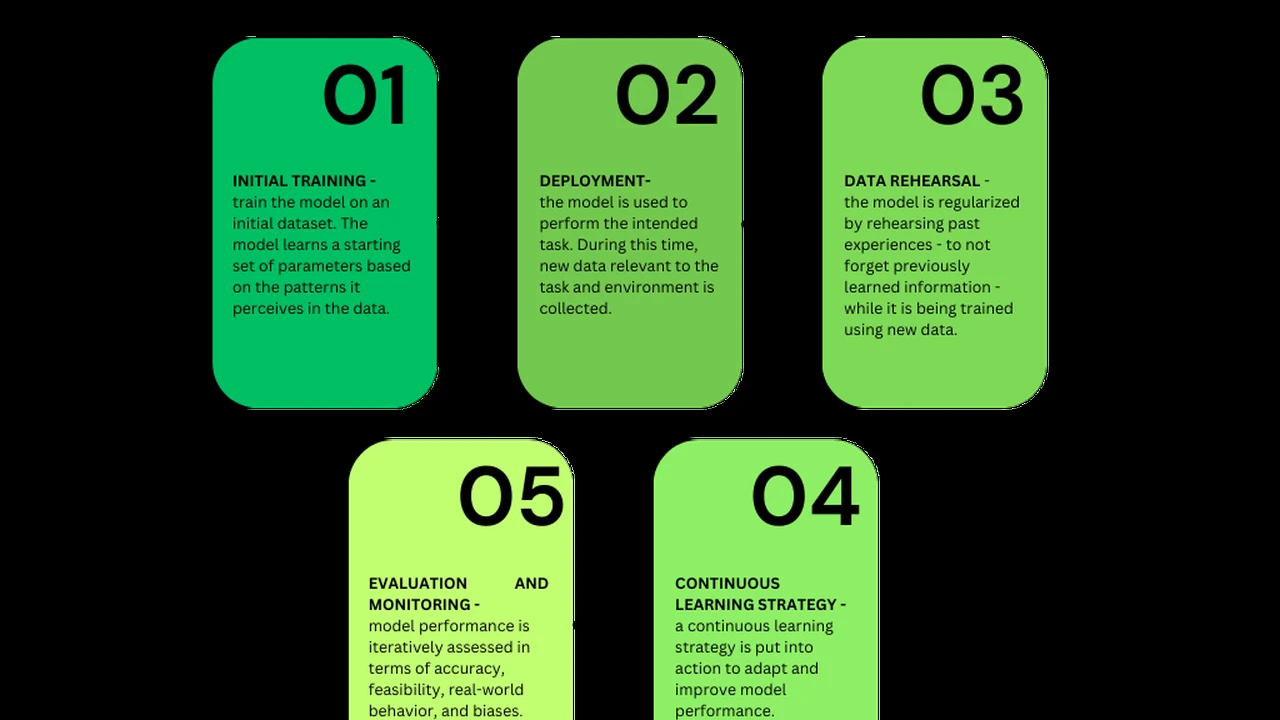
Emphasizing the need for lifelong learning to stay relevant in the dynamic AI landscape.
The Importance of Continuous Learning in AI
Hey there, future-proofers! Let's chat about something super crucial in today's tech world: continuous learning, especially when it comes to Artificial Intelligence. The AI landscape is moving at warp speed, right? What was cutting-edge yesterday might be old news tomorrow. So, if you're looking to stay relevant, competitive, and frankly, just plain awesome in this field, you've gotta commit to being a lifelong learner. It's not just a nice-to-have; it's a must-have.
Why Continuous Learning is Your AI Superpower
Think about it: AI isn't just one thing. It's machine learning, deep learning, natural language processing, computer vision, robotics, and so much more. Each of these sub-fields is evolving independently and also influencing each other. If you learn one thing and stop, you're going to miss out on the next big breakthrough. Continuous learning ensures you're always equipped with the latest knowledge and skills, making you an invaluable asset in any AI-driven environment.
Staying Ahead of the Curve AI Trends and Innovations
New AI models, frameworks, and applications are popping up almost daily. Remember when GPT-3 blew everyone's minds? Then came GPT-4, and now we're talking about even more advanced models. If you're not actively learning, you'll quickly fall behind. This isn't just about knowing the names of new models; it's about understanding their capabilities, limitations, and how they can be applied. For instance, knowing the difference between a transformer model and a recurrent neural network, and when to use each, is key. Keeping up with research papers, attending webinars, and following leading AI researchers on platforms like X (formerly Twitter) or LinkedIn can give you a significant edge.
Adapting to New AI Tools and Platforms
The tools we use in AI are constantly changing. TensorFlow and PyTorch are still dominant, but new libraries and platforms emerge regularly, offering more efficient ways to build, train, and deploy AI models. For example, Hugging Face has become a go-to for NLP models, and platforms like Google Cloud AI Platform or AWS SageMaker are constantly updating their services. Being open to learning new tools and experimenting with them is vital. It's like a chef always trying new ingredients and cooking techniques to improve their dishes.
Enhancing Problem Solving Skills with Evolving AI Techniques
AI is all about solving complex problems. The more you learn, the more techniques you add to your arsenal. Maybe a problem you couldn't solve with traditional machine learning can now be tackled with a specific deep learning architecture. Or perhaps a new reinforcement learning algorithm opens up possibilities for autonomous systems. Each new piece of knowledge enhances your ability to approach and solve real-world challenges using AI.
Practical Ways to Embrace Continuous AI Learning
Okay, so we agree continuous learning is important. But how do you actually do it? It's not about going back to university for another four years (unless you want to!). It's about integrating learning into your daily or weekly routine. Here are some actionable strategies:
Online Courses and Specializations for AI Mastery
Online platforms are a goldmine for structured learning. They offer everything from beginner introductions to advanced specializations. Here are a few top picks:
- Coursera: Offers numerous specializations and professional certificates from top universities and companies.
- Deep Learning Specialization by Andrew Ng (Stanford/DeepLearning.AI): This is a classic and highly recommended for anyone serious about deep learning. It covers neural networks, CNNs, RNNs, and more.
- AI for Everyone by Andrew Ng: Great for non-technical folks or those wanting a high-level overview of AI's impact.
- Pricing: Often subscription-based (Coursera Plus, around $59/month) or per-course payment (typically $49-$79 for individual courses, specializations can be $399-$799). Financial aid is often available.
- Use Case: Building a strong foundational understanding of core AI concepts and practical implementation.
- edX: Similar to Coursera, with courses from universities like MIT, Harvard, and Berkeley.
- Professional Certificate in Data Science (HarvardX): While broader than just AI, it provides essential data science skills crucial for AI.
- Pricing: Similar to Coursera, with verified tracks ranging from free (audit) to $100-$300 per course, and programs costing $500-$1500+.
- Use Case: Gaining university-level knowledge and credentials without the full degree commitment.
- Udemy: More project-based and practical courses, often taught by industry professionals.
- Python for Data Science and Machine Learning Bootcamp (Jose Portilla): Excellent for hands-on coding and practical application of ML algorithms.
- Pricing: Courses are individually priced, often heavily discounted (from $12.99 to $199.99).
- Use Case: Learning specific skills or tools quickly and practically.
- DataCamp: Focuses heavily on interactive coding exercises for data science and AI.
- Machine Learning Scientist with Python Track: A comprehensive path covering various ML algorithms and techniques.
- Pricing: Subscription-based, around $25/month for premium access.
- Use Case: Hands-on coding practice and building a portfolio of data science and AI projects.
Reading Research Papers and Technical Blogs for AI Insights
This might sound intimidating, but it's where the bleeding edge of AI is published. Start with review papers or survey articles to get a broad understanding of a topic. Then, dive into specific papers that interest you. Websites like arXiv.org are where most new AI research is first published. For more digestible content, follow technical blogs from companies like Google AI, OpenAI, Meta AI, or independent researchers. They often break down complex topics into understandable pieces.
Hands-on Projects and Experimentation in AI Development
You can read all you want, but nothing beats getting your hands dirty. Pick a small project, even if it's just replicating a paper's results or building a simple AI application. This helps solidify your understanding and exposes you to real-world challenges. Platforms like Kaggle offer datasets and competitions that are perfect for practicing your skills. Try building a simple image classifier, a text summarizer, or even a small chatbot. The process of debugging and problem-solving is invaluable.
Attending AI Conferences and Webinars for Networking and Learning
Conferences (even virtual ones) are fantastic for learning about the latest breakthroughs, networking with peers, and getting inspired. Look for events like NeurIPS, ICML, AAAI, or local AI meetups. Many organizations also host free webinars on specific AI topics. These are great for quick updates and hearing directly from experts.
Joining AI Communities and Forums for Collaborative Learning
Being part of a community can significantly boost your learning. Join Discord servers, Reddit communities (like r/MachineLearning or r/deeplearning), or LinkedIn groups dedicated to AI. You can ask questions, share your progress, get feedback, and learn from others' experiences. This collaborative environment is incredibly powerful.
Recommended AI Learning Products and Platforms
Beyond the general course platforms, let's talk about some specific products and tools that can aid your continuous learning journey. These aren't just for building; they're also for learning by doing.
Jupyter Notebooks and Google Colab for Interactive AI Coding
- Product: Jupyter Notebooks (local installation) / Google Colab (cloud-based)
- Use Case: Interactive coding, experimentation, data exploration, and sharing AI models. Perfect for learning Python, TensorFlow, PyTorch, and other AI libraries.
- Comparison: Jupyter Notebooks run on your local machine, giving you full control but requiring setup. Google Colab runs in the cloud, offers free GPU/TPU access (limited), and requires no setup, making it ideal for beginners or quick experiments.
- Pricing: Both are free. Google Colab offers Colab Pro/Pro+ for enhanced resources (e.g., faster GPUs, longer runtimes) starting around $9.99/month.
- Why it helps learning: You can write code, run it, see the output, and add explanations all in one document. This makes learning iterative and highly effective.
Hugging Face Transformers for NLP and Generative AI Exploration
- Product: Hugging Face Transformers Library and Hub
- Use Case: Easily access and experiment with state-of-the-art pre-trained models for Natural Language Processing (NLP), computer vision, and audio tasks. Great for understanding how large language models (LLMs) work.
- Comparison: While you could build these models from scratch, Hugging Face provides an incredibly user-friendly interface and library to leverage existing powerful models.
- Pricing: The library is open-source and free. The Hugging Face Hub offers free access to thousands of models and datasets. Paid tiers for enterprise solutions exist.
- Why it helps learning: It democratizes access to complex AI models. You can download a pre-trained GPT-2 or BERT model and start fine-tuning it for your own tasks with just a few lines of code, allowing you to focus on application rather than foundational model building.
Kaggle for Practical AI Challenges and Datasets
- Product: Kaggle Platform
- Use Case: Participating in machine learning competitions, accessing diverse datasets, and learning from public notebooks (solutions shared by other users).
- Comparison: Unlike structured courses, Kaggle offers real-world, often messy, datasets and open-ended problems. It's a competitive environment but also a massive learning resource.
- Pricing: Free.
- Why it helps learning: It forces you to apply your knowledge to new problems, learn new techniques from top practitioners, and understand the nuances of data preprocessing and model evaluation.
TensorFlow and PyTorch Frameworks for Deep Learning Implementation
- Product: TensorFlow / PyTorch
- Use Case: Building, training, and deploying deep learning models from scratch or using pre-built components.
- Comparison: TensorFlow (developed by Google) is known for its production readiness and strong deployment options. PyTorch (developed by Meta) is often favored by researchers for its flexibility and Pythonic interface. Both are incredibly powerful.
- Pricing: Both are open-source and free.
- Why it helps learning: Mastering at least one of these frameworks is essential for any deep learning practitioner. They provide the fundamental building blocks for almost any advanced AI application. Learning them involves understanding neural network architectures, optimization algorithms, and data pipelines.
OpenAI API and Google Gemini API for Generative AI Application
- Product: OpenAI API (GPT-3.5, GPT-4, DALL-E, etc.) / Google Gemini API
- Use Case: Integrating powerful generative AI capabilities into your own applications, experimenting with prompt engineering, and understanding the potential of large language models.
- Comparison: Both offer access to cutting-edge generative AI models. OpenAI has been a pioneer with GPT series, while Google's Gemini is a strong contender with multimodal capabilities.
- Pricing: Usage-based pricing. For example, OpenAI's GPT-4 Turbo can be $0.01/1K tokens for input and $0.03/1K tokens for output. DALL-E image generation is around $0.02/image. Google Gemini pricing is competitive and also usage-based.
- Why it helps learning: You can quickly prototype ideas, build AI-powered features, and understand the practical implications of generative AI without needing to train massive models yourself. It's a fantastic way to learn prompt engineering and application development.
The Mindset of a Continuous AI Learner
Beyond the tools and resources, having the right mindset is paramount. It's about curiosity, resilience, and a willingness to embrace change.
Embracing the Unknown and AI Complexity
AI is complex, and there's always more to learn. Don't be afraid to dive into topics you don't fully understand yet. Embrace the challenge. It's okay not to know everything; the goal is to keep learning and growing.
Building a Learning Routine for AI Skill Development
Consistency is key. Dedicate a specific amount of time each week to learning, whether it's an hour a day or a few hours on the weekend. Treat it like any other important appointment. This could be reading a paper, watching a tutorial, or coding a small project.
The Power of Experimentation and Failure in AI
You're going to make mistakes. Your models won't always work as expected. That's part of the learning process. Every failed experiment is a lesson learned. Debugging and troubleshooting are crucial skills in AI, and they only get better with practice and persistence.
Networking and Collaboration in the AI Community
Don't learn in isolation. Connect with other AI enthusiasts, join study groups, and participate in discussions. Teaching others what you've learned is also a fantastic way to solidify your own understanding. The AI community is generally very supportive and collaborative.
So, there you have it. Continuous learning in AI isn't just a buzzword; it's the secret sauce to staying relevant and thriving in this incredibly exciting field. Keep that curiosity alive, keep experimenting, and never stop learning. The future of AI is being built right now, and you can be a part of it!
:max_bytes(150000):strip_icc()/277019-baked-pork-chops-with-cream-of-mushroom-soup-DDMFS-beauty-4x3-BG-7505-5762b731cf30447d9cbbbbbf387beafa.jpg)